|
Rhoda Willis – the last baby farmer to
hang.
|
Leslie James was the last woman to be
hanged for baby-farming and also the last woman to be hanged in Wales. Only on the day before her execution did she
reveal to her solicitor, Mr. Harold Lloyd, that her real name was Rhoda Willis,
having been charged, tried and convicted in the assumed name of Leslie
James. Apparently her motive for this
deceit was to avoid bringing shame on her family, according to the Western Mail
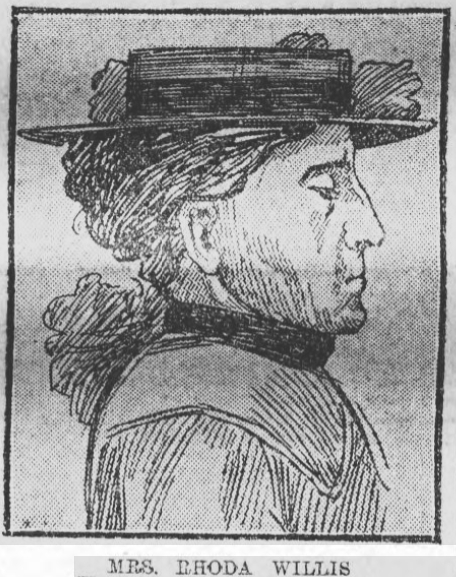
newspaper. Here is a newspaper
drawing of her, presumably made by an artist at her trial.
She was born Rhoda Leselles
in Sunderland and had been given a good education at a girls boarding school in
London. Around the age of 19 she met and later
married Thomas Willis, a marine engineer from her home town The couple moved to the Grangetown
area of Cardiff
where Rhoda gave birth to a daughter.
Thomas later died of natural causes leaving Rhoda on her own to bring up
their child. She took up with a Mr. E.
S. Macpherson, strangely another marine engineer and the couple lived together
for some time in Paget Street,
Cardiff, with Rhoda bearing him
two daughters before they decided to separate.
Rhoda went to live with her brother in Birmingham and the two children stayed with
their father. She later returned to Cardiff and had begun to
drink heavily and was generally going “down hill”.
In 1907 she was knocked down by a bicycle
and sustained a head injury which necessitated a lengthy stay in the workhouse
infirmary. After her release she was
convicted of her first criminal offence, the theft of a medal, for which she
received a short prison sentence.
The
murder.
Rhoda placed an advert for a baby to adopt in The
Evening Press and gave a Box No to reply to. One was received from a Mrs. Lydia
English, whose sister Maude Treasure was pregnant. It was agreed that Leslie
James, as Mrs. English knew her, would take the baby when it was born, which it
duly was on the 3rd of June 3 1907.
Rhoda collected the infant the following day (4th of June) and the
pre-agreed fee of £8 at Hengoed railway station and
took her by train back to her lodgings at Portmanmoor Road,
Splott, in Cardiff. It was on this train journey that she later
confessed to smothering the baby. Rhoda
wrote out a receipt for the money and Lydia and Maude had kept it. She had also written another letter to Lydia
English after the baby’s death in which she said "I am leaving for the
North. Have just given baby a nice bath. She is lovely."
Rhoda also received other replies to her
advertisement, including one from an Emily Stroud from Abertillery
who had had a baby on the
20th of March 1907. Rhoda
took this child and kept it until early May when she dumped it outside the
Salvation Army House in Cardiff,
with a note claiming she was an unmarried mother who could not cope. Sadly, the
baby was not discovered quickly enough and subsequently died eight days later as a result of suffering exposure.
Another child was adopted on the 8th of May, but this one was able to return to
its parents unharmed.
Her landlady, Mrs. Wilson, told the police
that Rhoda had gone out on the 5th of June and had returned home drunk. She
helped to get Rhoda to bed and noticed a bundle by the bed. When she opened it,
she was horrified to find the body of a newborn baby girl. She immediately sent for the police who
arrested Rhoda at the scene. She was
charged with murder and remanded in custody to the next Glamorgan
assizes.
She was tried at Swansea before Mr. Commissioner Shee on Tuesday and Wednesday, the 23rd and 24th of June
1907 on the one charge of murder of Maude Treasure’s unnamed baby. She pleaded not guilty and claimed that the
child had been ill and therefore died of natural causes. Examination of the
baby showed that it had been dead for between 12 and 48 hours when it had been
discovered, but had been healthy at birth.
The prosecution showed that she had died from asphyxia, having
been smothered, although the defence claimed that the suffocation could have
been accidental. This might well have
been accepted and led to an acquittal had it not been for the letter that Rhoda
had sent after the baby’s death.
Handwriting experts claimed that the writing on the note found with the
dumped baby outside the Salvation Army House was Rhoda’s as it matched the
writing in a letter sent by her to Lydia English and the receipt for the
£8. The jury
retired at 2.45pm on the
second day of the trial and took just 12 minutes to bring in a guilty
verdict. Commissioner Shee agreed with their verdict and told Rhoda "Don't let anyone suppose that because you are
convicted of murder that nobody pities you, nobody prays for you. "I
implore you to employ the short time that is left to you to prepare for death
and for that mercy which you will undoubtedly find in Heaven, but which you
cannot expect here.
"The sentence of
the court upon you is that you be hanged by the neck until you are dead, and
that your body be buried within the precincts of the prison in which you shall
have been confined before your execution, and may the Lord have mercy on your
soul!" She was then removed to the
condemned cell at Cardiff
prison, presumably because Swansea
prison did not have female facilities.
Cardiff City Council decided to draw up a
petition for a reprieve to be sent to the Home Secretary, Herbert
Gladstone. Alderman John Jenkins MP
promised to obtain a meeting with Gladstone
to explain the Council’s position. As
usual, especially in the case of a woman, public petitions were got up for a
reprieve. Rhoda’s solicitor received 120
letters on the Monday prior to the hanging in support of one, including two
from members of the coroner’s jury who thought that she was only guilty of
manslaughter. Herbert Gladstone was
unmoved by this agitation and confirmed that the law would take its course on
Wednesday as planned.
Rhoda asked the governor of Cardiff prison, Mr. H. B.
Le Mesurier, if she could have a meeting with her
former partner, Mr. Macpherson, which he allowed and sent Mr. Macpherson an
urgent telegram telling him to come at once.
They had their emotional meeting in the condemned cell and she gave him
a lengthy letter. This letter was
reported to be full of remorse and regrets but stated that she was resigned to
her fate and hoped God would forgive her.
She also beseeched him to keep the details of her fate from their two
daughters.
The gallows at Cardiff were housed in an execution shed in a
small yard quite close to the main gate and totally hidden from view by high
walls. The trap doors were level with
the floor and prisoner dropped into a brick lined pit. On the Tuesday prior to the execution the
prison staff tested the drop and Henry Pierrepoint and his brother and
assistant, Thomas, tested it again upon their arrival at the prison in the
early afternoon. Rhoda stood 5’ 2” tall and weighed 148 pounds, her drop being
calculated at 5’ 10”.
Around the same time on the Tuesday
afternoon that the Pierrepoint brothers arrived at the prison so did her
solicitor Mr. Lloyd and a warder mistook him for one the brothers. Mr. Lloyd had drawn up Rhoda’s will and had
bought it for her to sign and be witnessed by the matrons looking after
her. She left what little she had to Mr.
Macpherson to help him care for their daughters.
Late on the Tuesday evening Rhoda asked the Governor for another meeting with
Mr. Lloyd and he was contacted and agreed to be at the prison at 6.10 a.m. the
next morning. Rhoda made a full confession
to him in the condemned cell in an interview lasting nearly half an hour. She reportedly told him that she could not go
to her death without a clear conscience and that she did indeed wilfully murder
the baby on the train back from Hengoed, between Llanishen and Cardiff. She told Mr. Lloyd that a sudden temptation
(to kill the child) came over her and that she couldn’t resist it. She asked him to let the trial judge and
jurors know of her confession so that they would not have the execution of an innocent
woman on their consciences. The chaplain of Cardiff prison, the Rev. Arthur Pugh, then
gave Rhoda the sacrament.
To avoid any contact with the group of
seven men and one woman who were being released from the prison on the
Wednesday morning at the end of their sentences, the governor bought forward
their release to 7 a.m.
The execution had been set for 8 a.m. on
Wednesday, the 14th of August, 1907, which was also her 44th birthday. She was
still an attractive woman, her blaze of golden hair glinting in the morning
sunshine as she was led across the yard to execution shed. This was remarked upon by Henry Pierrepoint
in his diary. Present were the usual
officials, including the Under Sheriff, Mr. T T
Williams, the governor, Mr. H B Le Mesurier, the
chaplain Rev. Arthur Pugh and the prison surgeon Mr. J D Williams. As was usual with a female execution the
press were not admitted. It was reported
by a witness that Rhoda met her death bravely and died without a struggle -
"We learn from one who was present that the culprit's demeanour prior to
her execution was wonderfully calm, and she went to her death bravely. In fact,
the officials of the prison were lost in admiration of her fortitude. "She displayed far greater control over
her emotions than some men whom eye-witnesses of the execution had seen hanged.
"As she stepped out of the cell into
the open air she gave one glance towards the sky, the last she was to give
before being ushered into the presence of her Maker.” Her last words just before the lever was
operated were “Lord Jesus receive my soul.”
A large crowd had gathered outside the
prison to witness the official notices of the execution be put up on the prison
gates at around 8.30a.m.,
the event being photographed by the press and a few of the onlookers. The formal inquest was held later in the
morning and Mr. Williams gave the cause of death as fracture/dislocation of the
upper cervical vertebrae.
She was the last baby farmer to be hanged
and the seventh person to be executed at Cardiff
prison since it opened in 1854.
Comment.
It is interesting and disturbing to note that
Rhoda suffered a head injury and it is possible that this may have precipitated
her criminal behaviour. There is no
record of any offence prior to this injury being sustained. It was much harder to check for brain damage
in 1907 and as Rhoda appeared sane there was no obvious reason to try.
Although the Criminal Appeal Act had been
passed earlier in the year it could not help Rhoda as it had bee decided by
Parliament that it would only apply to persons convicted after the 18th of
April, 1908.
With special thanks to Monty Dart for
providing contemporary newspaper reports of this case.
Back to Contents Page
Baby farmers