|
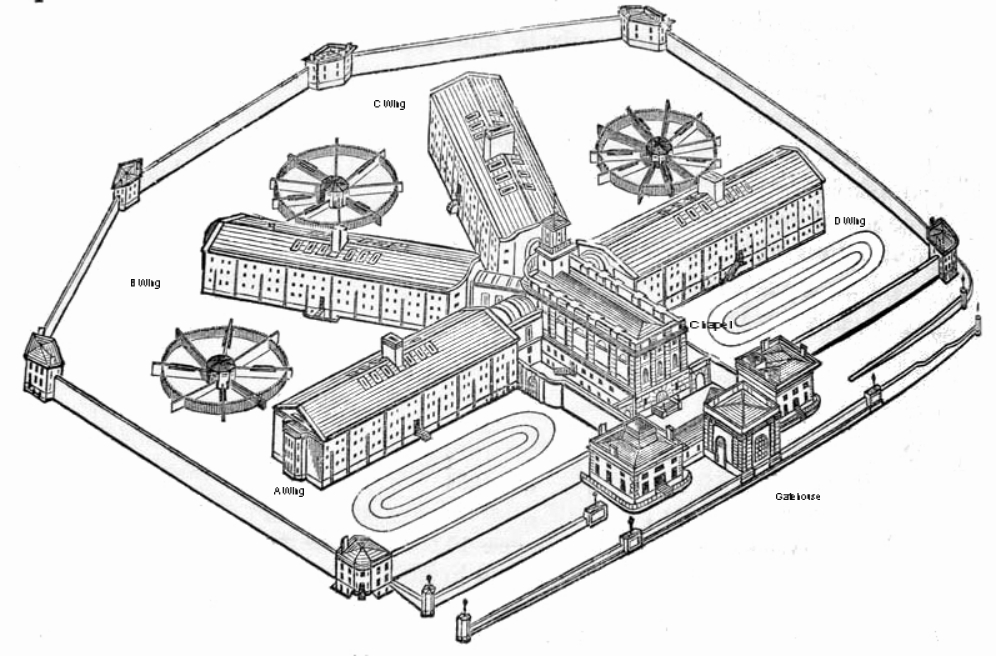
Pentonville prison, |
The first modern prison opened in London in 1816 - the new Millbank
prison. It had separate cells for 860 prisoners and proved satisfactory, to the
authorities at least, thus commencing a programme of prison building to deal
with the rapid increase in prisoner numbers occasioned by the ending of capital
punishment for many crimes and a steady reduction in the use of transportation.
Two Acts of Parliament were passed allowing for the building of
Pentonville prison for the detention of convicts sentenced to imprisonment or
awaiting transportation. Construction started on
Prisoners under sentence of death were not housed at Pentonville until
the closure of Newgate in 1902 when it took over responsibility for executions
for
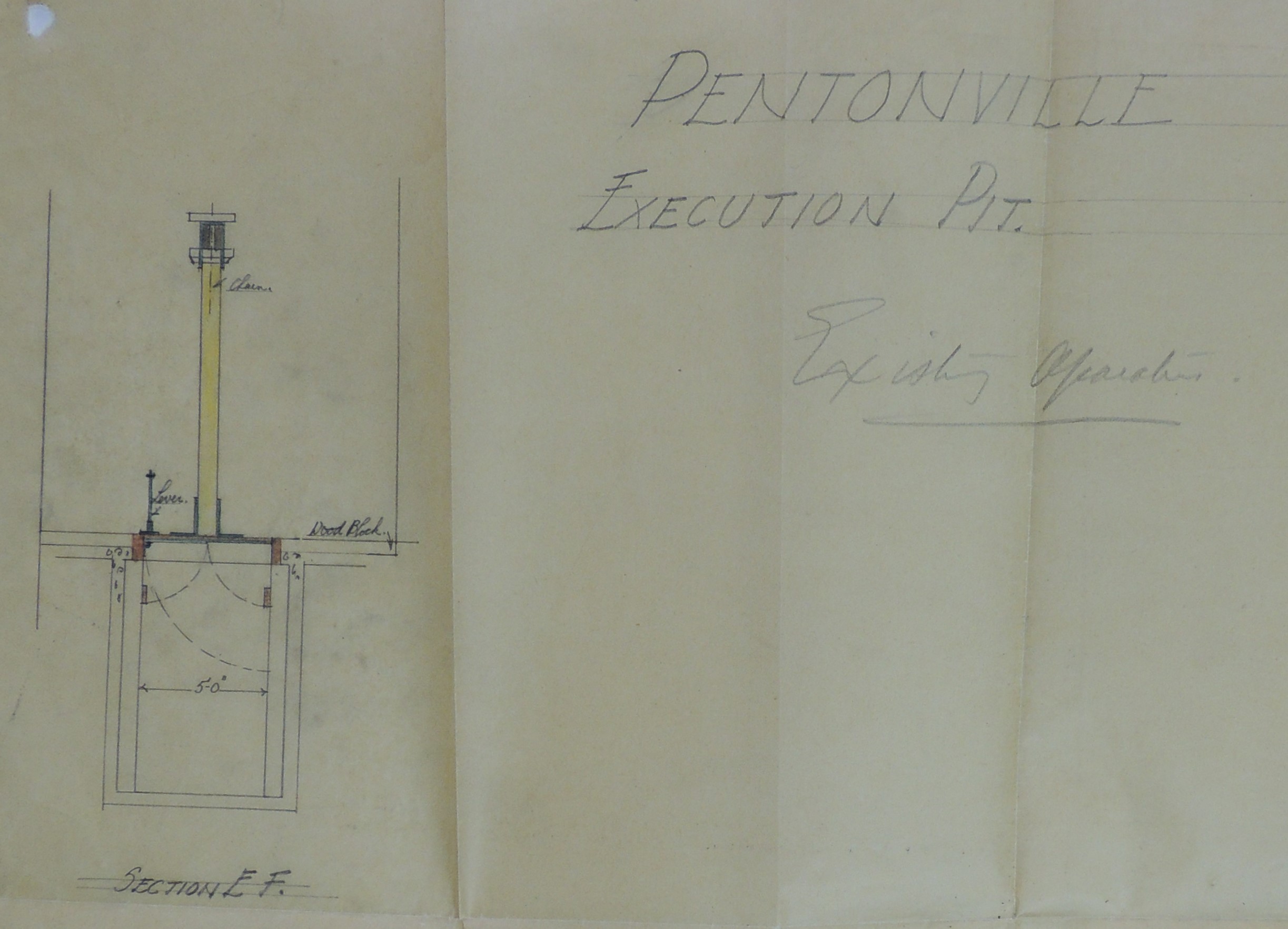
The gallows at Pentonville.
Pentonville's first execution facility originally consisted of a purpose
built shed adjoining B Wing. Execution sheds became the norm in most British
prisons, after the abolition of public hanging in 1868, and typically had the
trapdoors installed over a 12 feet deep brick lined pit, as drops of up to 10
feet could be given. They were often used as a garage for the prison van when
not required for executions.
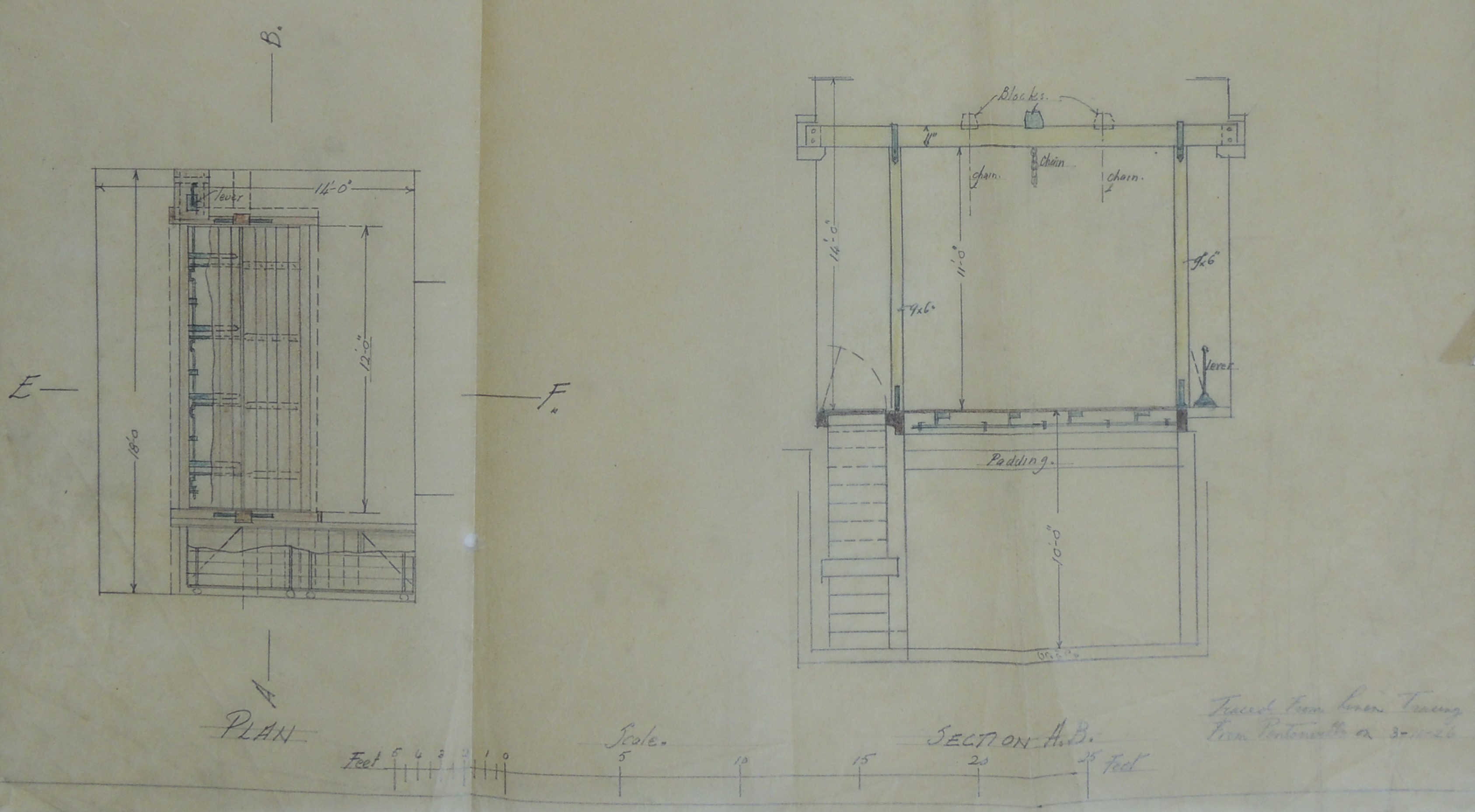
In 1926 work began on a new condemned suite, to save the prisoner having to
walk the 25 yards to the gallows, a new execution facility was provided within
the prison, comprising a stack of three rooms in A wing. The top most room
contained the beam from which up to three 2" link chains could be
suspended, for attachment of the rope(s) which hung down through floor hatches.
The beam and the adjusters for the chain can be seen on this plan.
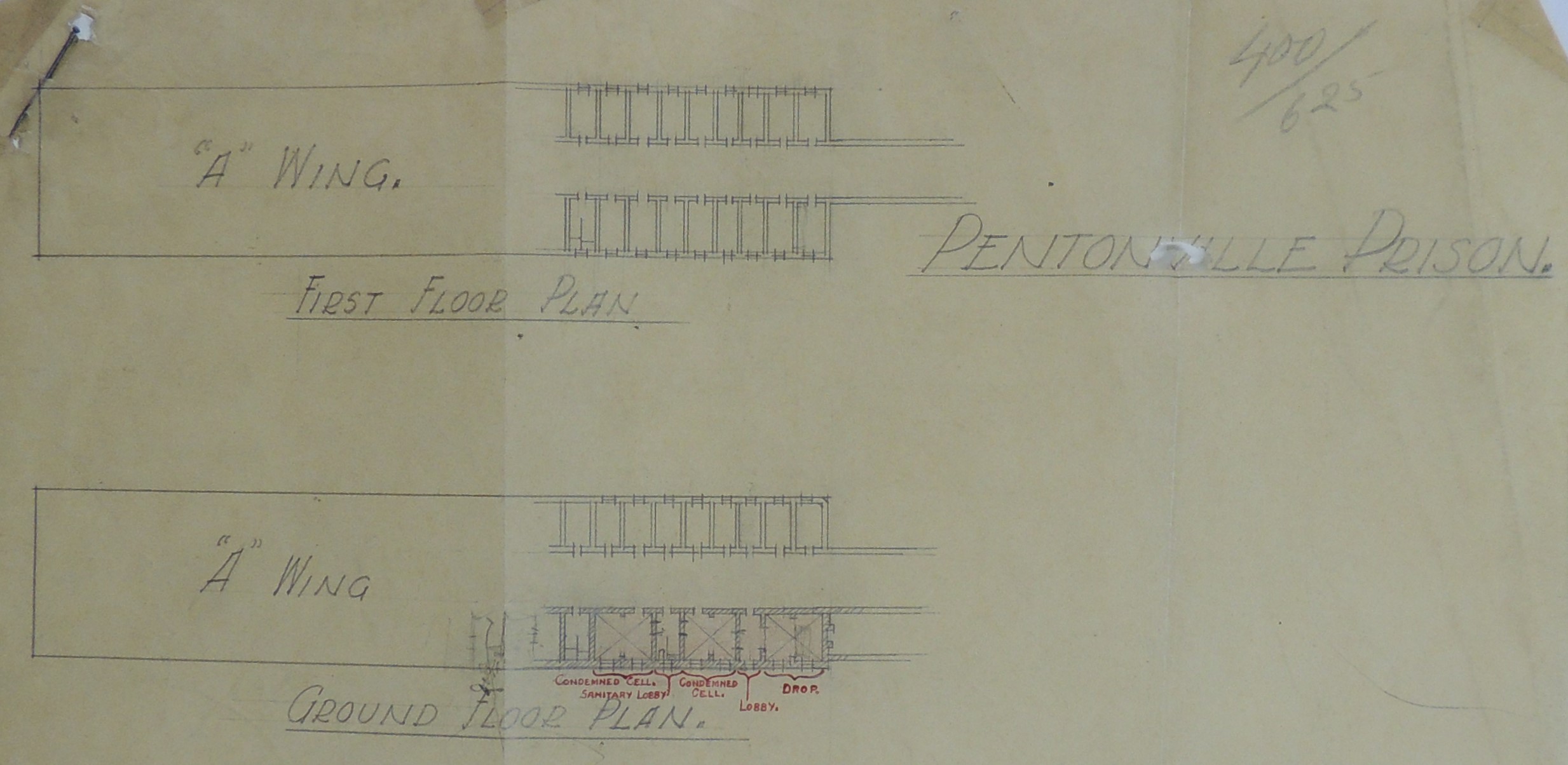
The suite was completed in 1928. See plan. The first floor room, painted a pale green,
contained the lever and trapdoors and the basement room acted as the
"pit" into which the prisoner dropped. See plan. Adjacent to this room was the mortuary room
where post mortems were carried out.
According to Prison Commission records the condemned suite was further
modernised in April 1937.
Albert Pierrepoint described the trap in 1931 as having two leaves, each some 8
feet 6 inches long by 2 feet 6 inches wide, with rubber backed spring clips to
catch them when they were released. Also on the first floor were the two
condemned cells separated from the execution chamber by an ante room or lobby
and from each other by a “sanitary lobby”. See plan. It was just 20 feet from No. 1 condemned cell
to the gallows.
A teaching prison for hangmen.
People who successfully applied to be added to the Home Office list of
executioners attended a one week course at Pentonville where they were taught
how to calculate and set the drop, pinion the prisoner and carry out an
execution with speed and efficiency using a dummy in place of the prisoner.
Albert Pierrepoint described this training in some detail in his autobiography.
The prison engineer was responsible for training new recruits and after they
had had their medical and interview with the governor, he took them straight to
the execution chamber where he showed them round and explained the equipment.
On the second morning, Albert and another trainee met "Old Bill" who
was the dummy used in place of a prisoner. They practised hooding and noosing
"Old Bill," getting the eyelet of the noose in the right place and
learning the system of humane hanging. This is "draw on the white cap,
adjust the noose, whip out the safety pin, push the lever, drop." They
repeated the process over and over until they became proficient and fast. The
next task was to learn to calculate the correct drop from the Home Office
tables. They were taught how to set the drop for differing weights of prisoners
by adjusting the length of the chain (the British rope was a standard length)
and shown how to carry out double executions. These involved getting the
prisoner in Condemned Cell 1 onto the drop and prepared before the prisoner in
Condemned Cell 2 is led out. Lots of other factors were discussed, e.g. what to
do with a prisoner who had earlier attempted suicide by cutting their throat
(not uncommon) or with a person who only had one leg or arm. At the end of the
week, they were given a final test, consisting of a full dummy execution. The
last training course was run in the week commencing Monday 25th April 1960, for Samuel
Plant and John Underhill, both of whom were successful and remained on the list
of assistant executioners until abolition.
Execution boxes and the gallows beam, where required, were sent from
Pentonville to those prisons that did not have permanent facilities. The boxes
contained two nooses, pinioning straps and white hood plus other ancillary
equipment.
Hangmen at Pentonville.
The first seven executions were carried out by William Billington with
John Billington doing the next one, before handing it over to Henry Pierrepoint
who officiated at the next seven. John Ellis carried out the next six,
interrupted by Tom Pierrepoint with the next two, before resuming for a further
17. William Willis hanged Frederick Bywaters as Ellis was busy at Holloway with
Edith Thompson. After Ellis resigned, the baton was handed on to Robert Baxter
for the next 24 executions.
Tom Pierrepoint did a further four hangings, two in 1937, one in 1941 and one
in 1943 (Charles Koopman), while Alfred Allen carried out his sole execution
here, that of Frederick Murphy in August 1937. Stanley Cross was to hang the
first three spies at Pentonville (see below). After that, Albert Pierrepoint
took over and with the exception of the one execution carried out by his uncle,
had a virtual monopoly until 1954. He executed 42 men between 1941 and 1954 and
carried out his first hanging as "No. 1" at Pentonville when he
executed Antonio Mancini on Friday, the 31st of October 1941.
Executions at Pentonville.
One hundred and twenty men were to be hanged at Pentonville between 1902 and
1961, an average of two per year. Of these, 105 suffered for civilian murders,
seven for Prisoner of War murders, one for treason and seven for spying during
wartime. Pentonville carried out, by a margin of three, the most 20th century
British executions. Its total represents 14.7% of 20th century English and
Welsh hangings for murder. The distribution of executions is quite patchy. The
war years were particularly busy with 25 executions between July 1940 and
December 1945. In other years, e.g. 1906 - 1908, 1914 & 1915 and 1938 -
1939, there were none.
Here are a selection of some of the more interesting cases:
John Macdonald became the first to be hanged at Pentonville, on the 30th of
September 1902 for the murder of Henry Groves, whom he had stabbed to death in
a dispute over 5 shillings (25p). He was executed by William Billington.
One of the most famous cases to end at Pentonville was that of 48 year
old Dr. Hawley Harvey Crippen, who had murdered his domineering wife, American
born Cora Turner (stage name Belle Elmore). The murder took place at Crippen's
house at 39 Hilldrop Crescent in London on or about the 1st of February 1910.
The marriage was not a happy one and she belittled him at every turn.
Eventually Crippen, who was having an affair with his secretary, Ethel Le Neve,
unable to stand her behaviour any longer, poisoned her with Hyoscine and then
dismembered the body and buried it in the cellar. After being interviewed by
the police over the disappearance of Belle, Crippen and Ethel Le Neve decided
to leave the country. They went first to Antwerp in Belgium where they boarded
the steamship SS Montrose bound for Canada. Ethel shared Crippen's cabin and
masqueraded as his son. Captain Kendall, the skipper of the Montrose,
recognised Crippen from a newspaper photograph and sent a ship to shore
telegraph from the Montrose to its owners who alerted Scotland Yard. This was
the first time a ship to shore telegraph had been used in a criminal case.
Inspector Drew of the Yard took a passage on the faster steamship, the SS
Laurentic, and was able to catch up with the Montrose in Canadian waters. He
boarded the Montrose from the pilot's launch on July 31st, 1911 and arrested
Crippen and Le Neve. This drama on the high seas filled the newspapers of the
time and together with the sinister sounding name of the prime suspect, made it
the "crime of the century" during that summer in the press. Crippen
came to trial at the Old Bailey on the 18th of October before Lord Alverstone,
the then Lord Chief Justice. The trial ended on the 22nd of October with the
jury taking less than 30 minutes to convict Crippen who was inevitably
sentenced to death. A clandestine photo of him in the dock was taken and this
has appeared in many books, (it was then and still is, illegal to photograph a
prisoner in the dock).
Crippen was returned to Pentonville to await his appointment with the hangman.
His last request, which was allowed, was to have a photo of Ethel Le Neve in
his top pocket when he was hanged at 9.00 a.m. on the dark and foggy morning of
Wednesday, the 23rd of November 1911 by John Ellis. He was 5' 4" tall and
weighed 136 lbs. so Ellis gave him a drop of 7' 9" inches. In his memoirs,
Ellis recalls that Crippen smiled as he walked towards him. A large crowd had
gathered outside the prison to see the execution notice posted.
Ethel Le Neve was charged with being an accessory to the murder but was
acquitted at her trial.
Frederick Henry Sedden (also given as Seddon) was a 40 year old poisoner
who was hanged by John Ellis on the 18th of April 1912 for the murder of Eliza
Mary Barrow. Again, John Ellis was the executioner. Sedden was 5' 3" tall
and also weighed 136 lbs and was given a drop of 7' 1". Approaching the
gallows in the execution shed in the prison yard, Sedden was somewhat unnerved
by the site of the noose and the sudden sounding of a loud horn of a tourist
coach passing the prison. Ellis was afraid he was going to faint and got the
execution over as quickly as he could - in just 25 seconds, a record at that
time.
Sedden had persuaded the wealthy Mrs. Barrow to sign over her several
properties to him in return for an annuity for the rest of her life. Obviously
the longer Mrs. Barrow then lived the more it would cost Sedden. She was only
50 at the time so potentially could have lived for many more years. The
prosecution at his Old Bailey trial in March 1912 contended that Sedden had
administered arsenic to her for this reason. The jury took an hour to find him
guilty although he maintained his innocence until the end.
Sir Roger Casement is unusual in that he was hanged for treason. His
execution took place on Thursday, the 3rd of August 1916 and was again carried
out by John Ellis. Casement was Irish by birth but held a British passport.
Soon after the outbreak of World War I, he moved from
Private Theodore William John Schurch was the other man hanged at Pentonville
for treason on the 4th of January 1946. Schurch, had been found guilty of
treason by a General Court Martial convened at the Duke of York's Regiment Head
Quarters in Chelsea London in September 1945.
One of the youngest men to suffer at Pentonville was Henry Julius Jacoby
who was just 18. He was hanged by Ellis on Wednesday, the 7th of June 1922 for
the murder of 66 year old Lady Alice White for whom he had battered to death in
her hotel room in the course of trying to rob her. Jacoby worked as pantry boy
in the hotel and quickly confessed to the murder. He was tried at the Old
Bailey on the 28th of April 1922, the jury making a recommendation to mercy, as
they were not convinced that the lad had intended to kill but rather that he
did so in panic when Lady White woke to find him in her bedroom and screamed.
Ellis recalls that Jacoby seemed completely unconcerned about his impending
fate and was playing a makeshift game of cricket with one of the warders in the
exercise yard on the afternoon before, when Ellis went too have a look at him.
After Ellis had pinioned his wrists in the condemned cell, Jacoby made a point
of thanking the governor and waiting prison officers for their kindness to him
in Pentonville. He went on to the execution shed and was described by Ellis as
the calmest person there. Jacoby was one of four teenage boys to be hanged
here. The others were 18 year old Arthur Henry Bishop on Friday, the14th of
August 1925, 19 year old John Frederick Stockwell on Wednesday, the14th of
November 1934 and 19 year old William Henry Turner on Wednesday, the 24th of
March 1943. Forty (33.3%) of the men who were executed were under 25 at the time
of their crime.
Things did not always go so smoothly as in the Jacoby case. John Ellis,
assisted by Albert Lumb, hanged two murderers on
On the 9th of January 1923, Frederick Edward Bywaters was led to the
gallows by William Willis for stabbing to death his lover's husband, Percy
Thomson. To the very last, he protested Edith Thompson 's innocence. At the
same moment, less than a mile away, she was being hanged at Holloway for her
part in the crime. Click here for more
details of this famous case which became a cause celebré.
A similar double execution was to take place on the 31st of May 1928
when Frederick Guy Browne was hanged at Pentonville while his accomplice
William Henry Kennedy was being executed at Wandsworth prison. Browne and
Kennedy both had criminal records and in the early hours of the 27th of
September 1927, were driving together in a stolen car in Essex. Police
constable George Gutteridge spotted them and signalled them to stop. Gutteridge
questioned them and was not satisfied with the answers they were giving him. He
took out his pocket book to record the events and as he did so, Browne fired
two shots at him from the driver's seat. These shots did not kill the constable
who staggered backwards and fell in the road. Browne got out of the car telling
Kennedy, "I'll finish the bugger" and standing over PC Gutteridge,
fired a shot into each of his eyes. Browne and Kennedy drove off to London
leaving PC Gutteridge dead in the road still holding his pencil. It was a crime
that appalled the nation at the time and made headline news. The police
questioned all those known to carry guns and in due course got to Browne, who
was arrested in January 1928, still in possession of the revolver that had been
used to murder PC Gutteridge. Kennedy was arrested in
Double executions, where the prisoners stood side by side on the same gallows,
were becoming less frequent in the
During World War II, Pentonville prison was closed to ordinary prisoners
but continued to house condemned inmates. Six spies were hanged at Pentonville
under the provisions of Section 1 of the Treachery Act 1940. They were Carl
Meier, José Waldburg, Charles Albert Van Der Kieboom, Oswald John Job, Pierre
Richard Charles Neukermans and Joseph Jan Vanhove.
José Waldburg was German while Carl Meier and Charles Van Der Kieboom were
Dutchmen, all of whom had landed on the
Oswald Job was born to German parents in
Pierre Richard Charles Neukermans was a Belgian who had been recruited by
German intelligence. He obtained legal access to Britain as a refugee but was
sending information on ship movements between Britain and the Belgian Congo to
the S.S. officer who had helped him "escape" from Nazi occupied
Belgium. He was tried in April/May 1944 and had his appeal dismissed on the 8th
of June. He was hanged by Albert Pierrepoint on the 23rd of June 1944.
Joseph Jan Vanhove was also
Unusually, five young prisoners of war were hanged at Pentonville on
Albert Pierrepoint, assisted by Steve Wade and Harry Allen, carried out the
executions. It is unclear from surviving records whether there were two double
hangings and a single or whether there were five single executions. They started at 9 am., and the notices of
execution were posted on the prison gate at 10.30 am., so the former scenario
seems more likely. These executions were
carried out under military jurisdiction, with Lieut-Col. F. Forbes, the Deputy
Provost Marshal for London District taking the place of the under-sheriff and
signing the notice of execution. Army
chaplains took the place of the prison chaplain.
A further two men were to be hanged for a similar offence the following month
after trial by court martial at
As execution facilities at county prisons closed some counties, e.g.
Twenty eight year old Neville George Clevelly Heath murdered two women,
his girlfriend Margery Gardner, aged 32, and 21 year old Doreen Marshall, both
in the summer of 1946. Heath had previous convictions and had been
court-martialled three times while serving in the forces during the war.
Margery Gardner enjoyed masochistic sex and Heath was a sadist so there was an
obvious bond. They acted out their fantasies in the Pembridge Court Hotel in
London's Notting Hill Gate where Heath tied Margery up and whipped her with a
diamond weave pattern leather whip. He had also bitten her breasts and inserted
an object into her vagina causing heavy bleeding, all before suffocating her,
probably to stifle her screams on the evening of Friday, the 21st of June. Her
body was discovered in Room 4 of the hotel by staff the following morning.
Heath had left the hotel and went to stay with his fiancée, Yvonne Symonds, in
Worthing in Sussex. Heath told Yvonne about the murder in the hotel and said
that Margery had gone to the hotel with a man named Jack and that he had let
them use his room. He also said that he had seen the body, although he did not
tell her that he had been in any way involved in the killing. After leaving
her, he wrote a letter to Scotland Yard telling them the same story. Passing
himself off as Group Captain Rupert Brooke, he met his second victim, Doreen
Marshall, at a dance in Bournemouth at the beginning of July 1946. He invited
her to dinner at his hotel and later murdered her. Again, her breasts were
savagely bitten and a sharp object had been thrust into her vagina. He hid her
naked body in bushes and covered it over with her clothes. The hotel manager
asked him to contact the police who were looking for Yvonne (as a missing
person) and he went voluntarily to Bournemouth police station for an interview,
where the sharp eyed detective noticed his strong resemblance to the photograph
of Neville Heath wanted in connection with Margery Gardner's murder. He was
duly arrested and charged with her murder and later with Doreen Marshall’s
murder as well. He was tried at the Old Bailey before Mr. Justice Morris on the
24th of September 1946 and put forward a defence of insanity which was
rejected. Three weeks later, on Wednesday, the 16th of October, he kept his
9.00 a.m. appointment with Albert Pierrepoint. His last request was for a large
whiskey.
Timothy John Evans and John Reginald Halliday Christie.
To the Old Bailey jury on that January afternoon in 1950, it must have seemed
like an open and shut case of a rather pathetic little man who had murdered his
baby daughter, Geraldine (the crime for which they were trying him), and who
had apparently confessed to the killing of his wife as well. There appeared to
be a strong prosecution case and he was duly found guilty and sentenced to
death, his execution taking place on Thursday, the 9th of March 1950. It was
one of those cases which would have faded almost instantly from the public
memory were it not to be for the gruesome discovery of more bodies at Evan's
erstwhile home, 10 Rillington Place, three years later.
The Evans had sublet their rooms at Rillington Place from John Christie,
an insignificant little man, bald and bespectacled, who was nicknamed
"Reggie no dick" by local children. He had a criminal record
stretching back some years. Christie murdered at least seven women. His victims
were Ruth Fuerst in 1943, Muriel Eady in 1944, Beryl Evans (Timothy's wife) in
1949, Ethel Christie (Christie's own wife) in 1952, Kathleen Maloney in 1953,
Rita Nelson and Hectorina MacLennan, also in 1953. Most of these women he had
lured to the house and then had gassed and strangled them. It is thought he
indulged in sex acts with them after he had rendered them unconscious, before
burying or hiding their bodies around the house and garden. In early 1953, with
the house somewhat crowded with dead bodies, Christie decided to move and
sublet the property to a Mr. and Mrs. Reilly who quickly noticed a foul smell
in the kitchen. When the owner investigated it, he discovered three of the
women's bodies hidden in an alcove off the kitchen which had been wallpapered
over. As one can imagine, this discovery made headline news. Christie had left
his lodgings and was wandering the streets before being apprehended on London's
embankment on March 31st, 1953. Under questioning, Christie admitted to the
murders of everyone except Geraldine Evans and seemed to be working on the
theory of "the more the merrier," probably in the hope of being found
guilty but insane. Christie would not, however, admit to killing the baby
despite repeated questioning and only admitted killing its mother after
sometime in custody. He came to trial at the Old Bailey on June 22nd, 1953
before Mr. Justice Finnemore and his counsel offered the expected defence of
insanity. The jury took just under an hour and a half to reject this and reach
a guilty verdict after a three day trial. Three weeks later, Christie stood
under the same beam as Evans had done and at 9.00 a.m. on the morning of
Wednesday, the 15th of July 1953, was also to be hanged by Albert Pierrepoint
as Evans had been. The Home Office allowed for the re-burial of Timothy Evans'
body in consecrated ground at St. Patrick’s Cemetary in
Britain’s last double (side by side) hanging took place at Pentonville
on Thursday, the 17th of June 1954, when 22 year old Kenneth Gilbert and 24
year old Ian Grant were executed by Albert Pierrepoint (assisted by Royston
Rickard, Harry Smith and Joe Broadbent) for the murder of 55 year old George
Smart in the course of a robbery. George
Smart was the hotel night porter at Aban Court Hotel in Kensington and on the
night of Tuesday, the 9th of March, caught these two young men breaking into
the hotel. They attacked him and then
tied him up and gagged him, ultimately causing his death by asphyxia. They blamed each other at the trial and
assured the jury that they had not intended to kill Mr. Smart. The jury were not impressed with this
argument and neither was Lord Goddard when he dismissed their subsequent
appeal. They had stolen just £2 and a
quantity of cigarettes – hardly worth dying for! Double hangings were outlawed by the Homicide
Act of 1957.
Twenty one year old Edwin Albert Arthur Bush became the last man to hang
at Pentonville on